In a Gram Sabha in Chhanvey block earlier this year, an elderly woman stood up hesitantly. She did not speak much. She simply signed the attendance register—slowly, carefully—for the first time in her life. Until a few months ago, her thumb impression had been enough. The room did not erupt in applause, but something had shifted. She had claimed a small yet powerful piece of agency. That moment stayed with us because it captured what this year has truly been about—not loud declarations of empowerment, but steady, irreversible shifts in confidence and participation.
The challenge we confronted as a team of development designers at Transform Rural India (TRI), while working with rural women in eastern Uttar Pradesh, is a structural paradox. The country has built an impressive architecture of women-centric schemes and institutional spaces: elected women representatives in Gram Panchayats, Mahila Mates under MGNREGA (now reimagined as Viksit Bharat–G RAM G), the National Rural Livelihoods Mission, and the mandated participation of women in Gram Sabhas. Yet in practice, much of this participation remains symbolic or proxy-driven.
This gap between institutional intent and lived reality is where TRI works. Designing with the community, not for it—a simple but powerful belief articulated by Kurt Lewin—guided our work this year: behaviour is a function of the person in interaction with their environment. If women are to exercise agency, the environment itself must enable learning, confidence, and participation.
This was not a product of theory alone. It emerged from listening.
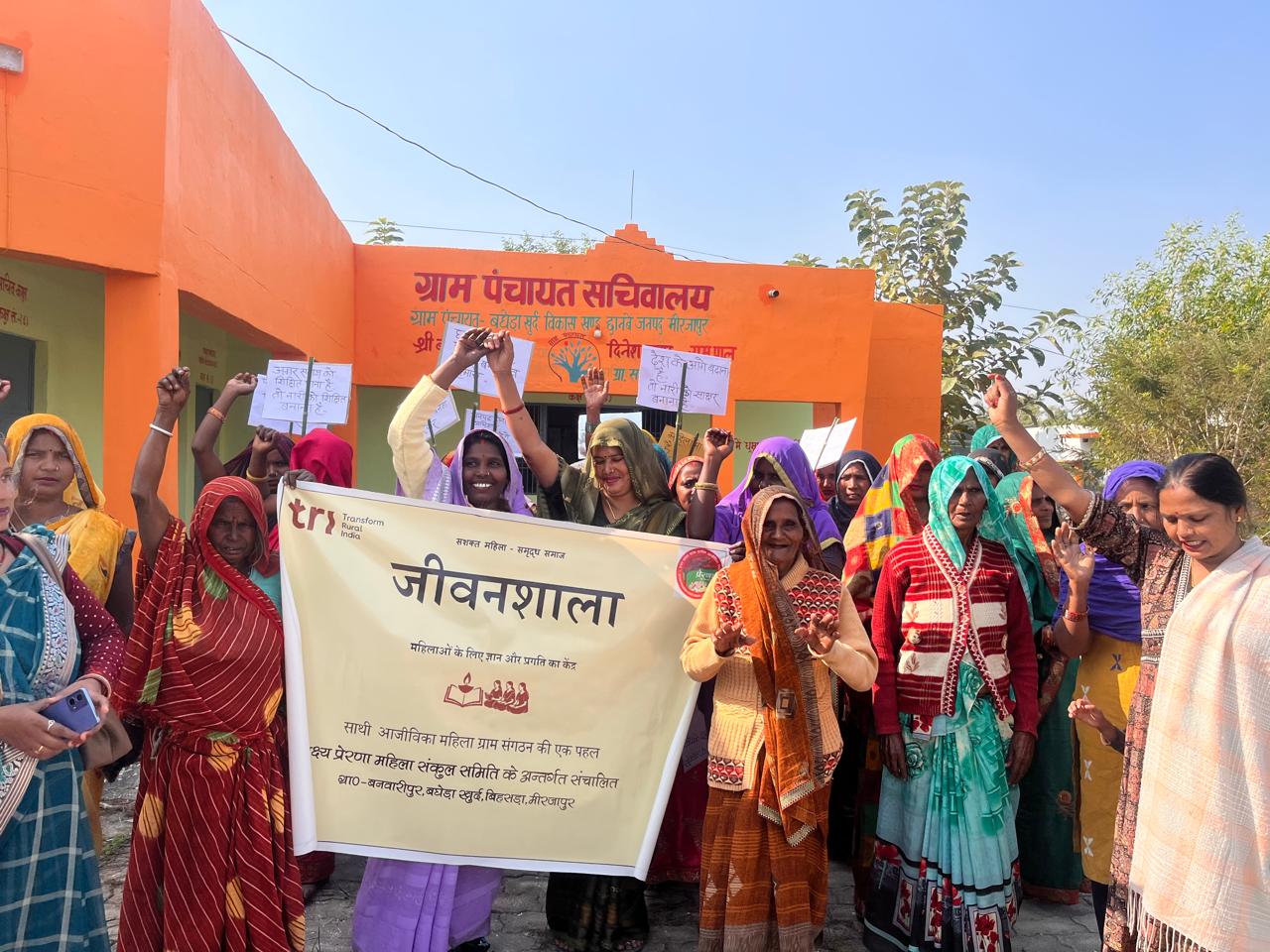
In May 2025, during a visioning exercise convened by the Lakshya Cluster Level Federation in Chhanvey block of Mirzapur, women leaders voiced a collective aspiration—“Shikshit Didi, Har Didi Shikshit Ho.” From this shared imagination emerged Jeevanshala: a school of lifelong learning, of women, for women, and by women. Jeevanshala was not introduced as an external programme. It grew organically from what empowerment meant to women themselves.
Village Organisations took ownership. They identified non-literate women, mobilised enrolment, pooled funds for learning materials, and invited volunteer teachers from within the community. What began as basic literacy sessions soon expanded into something much larger—a shared space where women could learn together, ask questions, and build confidence over time.
Gram Panchayats took note of this momentum and stepped in as partners. They provided physical space, stationery support, and public endorsement. The leadership of Mahila Pradhans proved pivotal in legitimising Jeevanshala. This convergence between women’s collectives and Panchayats transformed Jeevanshala from an activity into an institution.
Jeevanshala was co-designed as an enabling foundational platform anchored at the Gram Panchayat level, rather than as a new scheme. Once foundational literacy is established and no woman in the village remains illiterate, Jeevanshala transitions into a continuous learning and engagement space. It supports women’s understanding of civic rights and leadership, Panchayat processes and Gram Sabha participation, health, nutrition and livelihoods, functional financial and digital literacy, and access to public schemes and entitlements.
What changed in the system
Over the year, Jeevanshala spread across seven Gram Panchayats in two districts of Uttar Pradesh—Mirzapur and Varanasi. The outcomes, though early, are telling.
For the first time, women were handed the keys to the Panchayat Bhavan not as visitors, but as rightful users of the space. Their growing presence marks a quiet shift of power in a place they once entered with hesitation.
Women of all ages, including the elderly, joined voluntarily. Many moved from thumb impressions to signatures. Women began reading basic information on ration cards, bank slips, and health records. Gram Sabha meetings saw larger and more confident participation by women. Learning sessions organically expanded into discussions on health, nutrition, financial literacy, and agriculture.
More importantly, the nature of participation changed. Women are no longer just present; they are prepared. They ask questions. They follow up. Proxy leadership among elected women representatives has begun to weaken as knowledge replaces dependence.
Three reflections stand out. First, empowerment must come before participation. Without functional literacy and civic understanding, institutional spaces remain hollow. Second, this year reaffirmed that solutions emerge when development actors collaborate rather than work in isolation. Ownership proved central to sustainability. Jeevanshala thrived because women’s collectives and Panchayats led the process, with TRI deliberately leading from behind. Third, small changes compound—a signature today, a question tomorrow, leadership over time.
The work of organisations like TRI matters because systemic change does not come from parallel programmes. It comes from reimagining how existing systems function, grounding solutions in community aspirations, and bridging policy intent with lived reality.
Looking ahead to 2026
As we move into 2026, our focus is clear: strengthening women as active agents of governance and development. We will deepen convergence across line departments, strengthen simple, community-owned mechanisms to track scheme coverage, and embed local solutions. Real change will not be forged in conference rooms or policy corridors. It will take shape in everyday spaces where women learn together, deliberate together, and, over time, assume authorship of their own development.
And if India is to become a developed economy by 2047, it will not happen until rural women are no longer passive participants, but active architects of change.