On a winter morning in January, 13 newly selected Jharkhand Public Service Commission (JPSC) trainees arrived at Korambae Panchayat. From 9th to 11th January 2025, the village became their classroom, as part of a village immersion programme hosted by Transforming Rural India (TRI) team of development designers in Gola. Over the next 2 days, learning would unfold not through lectures or slides, but through conversations, visits, and time spent in shared spaces.
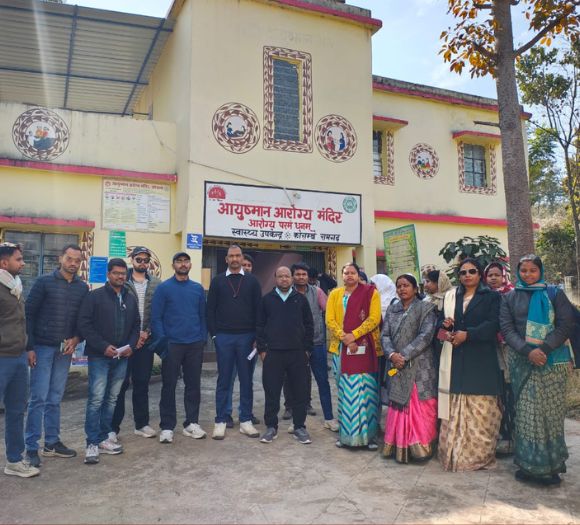
The immersion began at the National Quality Assurance Standards (NQAS) certified Ayushman Arogya Mandir. Inside the health centre, trainees spoke with the Community Health Officer (CHO) about daily service delivery and the public health system. They learned how TRI works through the Neighbourhood of Care (NoC) approach to strengthen health-seeking behaviour at the community level. Here, national health policies appeared not as documents, but as routines, registers, and steady interactions with patients.
From healthcare, the group moved to Korambae High School. In classrooms equipped with smart and digital facilities, they engaged with school management to understand how Sarva Shiksha Abhiyan and the National Education Policy are implemented locally. What is framed at the national level as reform was visible here in lesson planning, classroom practices, and school administration.
Governance came into focus during a Gram Panchayat Coordination Committee (GPCC) meeting. Seated alongside Panchayati Raj Institution (PRI) members, GPCC representatives, and Village Organisation (VO) members, the trainees explored the Village Poverty Reduction Plan (VPRP), Gram Panchayat Development Plan (GPDP) process. As discussions unfolded, the Mukhiya shared how TRI’s support has helped make the GPCC more structured and strengthened leadership within the Panchayat.
Beyond meeting rooms and classrooms, the learning continued in the fields. At the Solar Lift Irrigation site, members of the Water User Group explained how round-the-year irrigation supports crop yields and incomes for marginalised farmers. Under the Birsa Harit Gram Yojana (Mahatma Gandhi National Rural Employment Guarantee Act – MNREGA), trainees observed plantation, inter-cropping, and drip irrigation practices. Nearby, at the net house, farmers demonstrated protected cultivation of capsicum, English cucumber, and nurseries using drip irrigation systems, showing how high-value crops are grown under controlled conditions.
The final stop was the WOW (Work. Opportunity. Well Being) Hub at Chadi Panchayat. Here, the TRI team introduced the trainees to youth and women entrepreneurship models that are helping communities explore new livelihood pathways. The visit added another layer to their understanding of how economic opportunities are being shaped at the local level.
Over the course of the immersion, the trainees moved from health centres to classrooms, from Panchayat meetings to farms and enterprise spaces. Each stop revealed a different part of the system. Together, they showed how community institutions, government programmes, and local leadership intersect in everyday village life.
By the time the trainees prepared to leave Korambae, they had seen governance not as a set of separate schemes, but as a living network of people, places, and practices. What began as an exposure visit became a close encounter with development in action, rooted firmly in the rhythms of the village.