Nilima did not imagine a life beyond her home for many years. Travel, work, and public interaction were unfamiliar territory. Today, she is known across several villages in Dharashiv district of Maharashtra as an Arogya Sakhi.
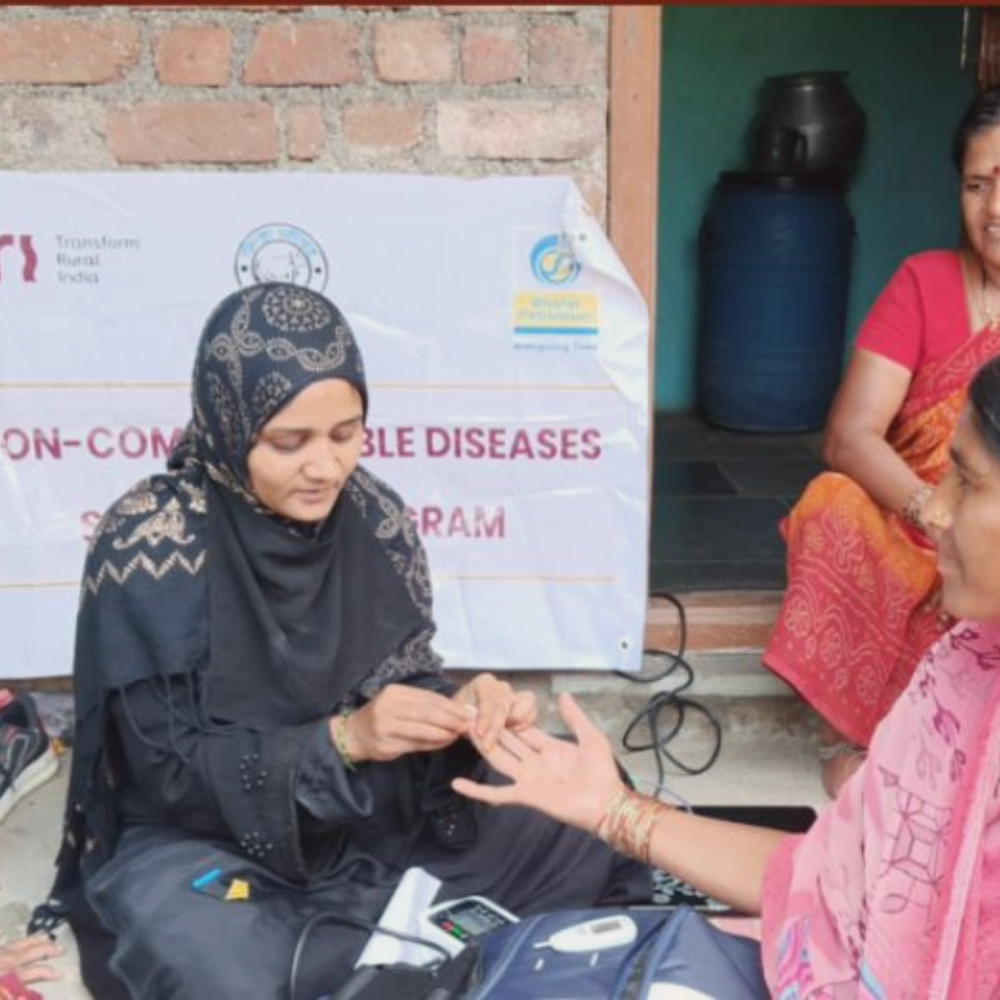
An Arogya Sakhi, or Health Friend, is a community cadre created under Transform Rural India’s Non-Communicable Disease (NCD) initiative, Mission Anandi. The programme focuses on improving women’s health, with a specific emphasis on breast and cervical cancer awareness and prevention. For women like Nilima, this role has become central to how they see themselves and how they are seen by others.
When Nilima first appeared for her interview at the Padoli Cluster Level Federation, she was confident and articulate, but visibly nervous. It was her first-ever interview; family circumstances had earlier prevented her from stepping out for work. Despite this, she gave her best, was selected, and went on to perform well in her role.
Before joining Transform Rural India as a cadre member, Nilima Tai had never travelled independently for work. Over time, with support and capacity-building training from TRI, she began visiting villages daily, conducting awareness meetings, and engaging directly with women on issues related to non-communicable diseases. She became recognised as an Arogya Sakhi across multiple villages. Through consistent field engagement, she built a professional identity that had previously been unavailable to her.
Such journeys often remain unnoticed. While women’s participation in education and employment has increased in many spaces, there are still numerous women in rural areas who have never travelled alone, attended SHG or Village Organisation meetings, or worked outside the home. Barriers include lack of opportunity, restrictive family environments, and deeply gendered expectations.
Nilima reflects that she had performed well in school but was married early due to circumstances. After her father’s sudden death, financial pressures increased, and she began to believe that earning an income was essential. Joining TRI as a cadre member and continuously working to improve the health and hygiene of girls and women around her has given Nilima more than financial independence. Today, she is involved in household decision-making, her income allows her to invest in a better future for her family, and her work impacts the lives of hundreds of women around her.
A similar shift is visible in the journey of Kalpana from the Ter Cluster Level Federation. She previously worked as an agricultural labourer and joined TRI to support her household financially. Over time, she emerged as one of the most active Arogya Sakhis in her area. She now conducts awareness sessions for groups of 30 to 40 women and speaks confidently about cancer prevention.
Kalpana shares that she once struggled to speak even among friends. Today, she is addressed as “Madam” and sometimes even “Doctor” by community members, though she prefers being called “Tai.” Through her work, she has been able to support her daughter’s education and contribute financially to her household.
Both Nilima and Kalpana describe how fieldwork reduced the mental fatigue caused by monotonous routines. Regular interaction with communities, travel, and learning helped improve their confidence and overall well-being. Support from family members, particularly spouses, played an important role, even as domestic responsibilities continued alongside professional work.
These stories reflect the experiences of many women fieldworkers in rural areas. Government missions, development programmes, and social sector initiatives rely heavily on women to mobilise communities, spread awareness, and implement interventions. Their roles range from health screenings and vaccination drives to SHG financial transactions and community outreach. Many travel extensively and use personal resources to carry out their work. Women fieldworkers are integral to sectors such as health, education, governance, finance, and livelihoods. Their involvement shapes planning, implementation, and outcomes on the ground.
Today, Nilima aspires to become a nurse, and Kalpana hopes to continue working in the social sector. Their journeys show how structured opportunities, community-based roles, and sustained engagement can enable women to build confidence, identity, and agency within existing systems. The work of Transform Rural India demonstrates how investing in women as field-level actors strengthens both individual lives and public systems from within.